RELAXED TRY DIVES FOR BEGINNERS IN SOUTH TENERIFE
Does Group Size Matter When You Learn to Scuba Dive? An Honest Answer
Most dive schools promise "small groups" — but what does scuba diving group size really mean for beginners? Sea Wolf Scuba in Tenerife keeps it 2:1, max.
By Brian Harrison, PADI Master Scuba Diver Trainer · Sea Wolf Scuba · Tenerife
6/19/20266 min read
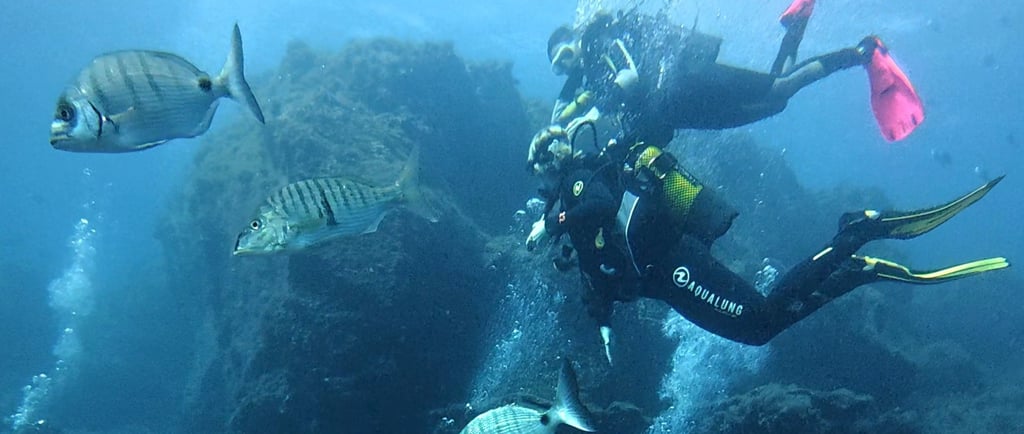
Almost every dive school promises “small groups.” Here’s what that phrase usually hides — and why it actually matters when you’re trying scuba diving for the first time.
If you’ve been searching for a try dive or a Discover Scuba Diving experience, you’ll have noticed that nearly every operator uses the same two words: “small groups.” It sounds reassuring. It sounds personal. But “small” is doing a lot of heavy lifting in that sentence, and most people booking their first dive have no idea what it really means in practice. So let’s be straight about it.
What does “small group” actually mean in scuba diving?
Here’s the bit the marketing doesn’t spell out. In a Discover Scuba Diving experience — the proper name for a beginner try dive — a single instructor is permitted to take a group of up to four people into the water at once. Four. On the face of it, four sounds like a small group. And it is small, compared to a coachload of tourists. But here’s the catch: four isn’t a generous, considered number someone has chosen for your benefit. Four is the maximum. It’s the most one instructor is allowed to supervise, full stop, and plenty of operators run right up to that limit because, financially, it makes complete sense to do so.
So when a dive school says “small group,” what they often mean is “the maximum number of people the rules will let us put with one instructor.” It’s technically true. It’s also a clever way of turning a legal ceiling into a marketing feature. Four might be small on paper — but it’s not small when it’s your face going underwater for the first time and there are three other beginners the same instructor is trying to watch at the same moment.
What is the instructor-to-student ratio at Sea Wolf Scuba?
At Sea Wolf Scuba, you’ll never be more than two people to one instructor. At times it’s just you, on your own, with me. That’s a 2:1 ratio at most, against the 4:1 the standards would allow.
And to be clear, this isn’t about turning people away or only taking tiny bookings. If there are four of you who want to dive together, brilliant — you absolutely can. I’ll just bring a second instructor along so it stays 2:1. What I won’t ever do is put four beginners with a single instructor and wave it through as a “small group.”
And I’ll be honest about what that costs me, because that’s the whole point of this post. Putting four people with one instructor is the easiest money going — same dive, one wage to pay instead of two, and the difference drops straight into my pocket. Staffing it properly means paying that second instructor out of the same booking. I do it anyway, every single time, and I sleep just fine on it. That’s a choice, not an accident.
Does a smaller group really make a difference for beginners?
For a complete beginner? Massively — and there are two halves to why. The first is space. On the single strangest thing your body has ever done, you shouldn’t be packed in shoulder to shoulder with your mate, or worse, a total stranger, all jostling for the same little patch of water. You want a bit of room to just be, to take it in, to have your own moment with it.
The second half matters even more: I believe you should always have an instructor within arm’s reach. The first time you breathe underwater, your body doesn’t entirely believe what you’re doing. It’s natural to feel a flicker of panic, to want reassurance, to need someone right there. With a 2:1 ratio, I am. If something feels off — your mask, your breathing, a wobble of nerves — I’m there before it becomes a problem. That’s exactly what the ratio buys you: space to enjoy it, and a professional close enough to touch.
In a group of four on one instructor, that instructor is splitting their attention four ways, constantly counting heads, never fully focused on any single diver. It's not unsafe, and most of the time it’s fine. But “most of the time” isn’t the standard I want for someone breathing underwater for the very first time. That’s the difference between a calm first dive and a stressful one.
The bit most dive schools won’t tell you
Here’s the honest reason, the one nobody puts on their website: I want to enjoy my day too. And if you’ve seen any of my videos, you already know I’m not faking that bit — I’m mad about this sport. Genuinely. Here’s a confession most instructors would never make: I’d rather teach a nervous first-timer than go off on a cracking dive by myself. Watching someone take that first breath underwater and watching them progress — that never, ever gets old. That’s the actual job. That’s the good stuff.
I didn’t walk away from a well-paid career to spend every day maxed out, stressed, counting heads and counting cash, herding the biggest group the rules allow. I teach scuba because I love it — and you can only love a thing if you’re actually present for it. Keep the ratio tight and I’m relaxed, I’m grinning, I’m enjoying your first dive right alongside you. And here’s the thing about nerves: they’re contagious — but so is calm. A relaxed instructor makes a relaxed diver. A stressed one, spread too thin, does the opposite, whether they mean to or not.
So when you dive with Sea Wolf Scuba, you’re getting three things at once: a better experience because nobody’s ever spread thin; full, undivided attention because there’s the room and the ratio to give it; and an instructor who’s genuinely, properly buzzing to be there. I built Sea Wolf to be exactly what I’d have wanted on the day I first tried scuba myself — and a calm instructor with real time for me would have been right at the top of that list.
Who actually takes you diving?
There’s one more thing worth considering before you book anything, anywhere. At a lot of schools — not all, but a lot — the instructor who takes you down is there because it’s their job. And that’s completely fair enough: they turn up, they’re handed the day’s plan, the groups and the numbers, and they make the best of whatever they’re given. Plenty of them are excellent at it. But they didn’t choose the ratio, they didn’t choose the schedule, and they clock off at the end like anyone else with a job.
To be clear, there are some genuinely brilliant owner/instructor-run schools out there too, I learned at one, where the person who owns it still gets in the water and cares enormously — so this isn’t a “me versus everyone” thing. It’s just something most people never think to ask: who am I actually getting?
With Sea Wolf Scuba, the answer’s simple. You get me, the owner, from the first whataspp hello to the last handshake. Every decision that shapes your day — the ratio, the pace, the site, the time we take — is mine, and I’ve made all of them in your favour because it’s my Sea Wolf on the side of the van. I’m not working someone else’s plan. I’m living mine, and I want to be there start to finish — because this is the bit I left everything else behind for.
So — does group size matter?
Yes. It matters a lot on your first dive, and it’s the one thing that’s easiest to disguise with a friendly-sounding phrase. Next time you read “small groups,” ask the simple question: how many people, exactly, per instructor? The answer tells you everything. With Sea Wolf Scuba, it’s never more than two.
Still Weighing It Up?
If it's your very first time, the nerves are normal — I've written an honest take on whether scuba diving is hard and whether it's safe, both worth a read before you book. If you're not a confident swimmer, there's a post on that too. And if it's a family thing, here's how kids diving works from age 10.
When you're ready, drop me a message and tell me a bit about yourself — first dive or hundredth, nervous or raring to go. You'll be talking to me, Brian, the whole way through, and it'll just be you (or you and one other) in the water with me. That's the whole point.
(Lobo, the sea wolf, supervises from the mini bus. He approves of small groups too.)

Ready to Join the Pack?
Tell us your dates and whether it’s your first time diving.
Quick replies, clear pricing, zero pressure.
Meet Your Instructor (and the Sea Wolf)
I’m Brian, an English PADI instructor based in south Tenerife. I specialise in calm, confidence-building first dives for beginners.
Sea Wolf Scuba is a small, personal operation — slower pacing, tiny groups, and a strong focus on safety and comfort. I’m usually joined by Lobo, the little “sea wolf” who inspired our logo and supervises the surface intervals.