RELAXED TRY DIVES FOR BEGINNERS IN SOUTH TENERIFE
Is Scuba Diving Hard? Honest Answer for Beginners
Is scuba diving hard? No — not for a try dive in Tenerife. PADI instructor Brian explains why it's easier than you think, for any age or fitness level.
By Brian Harrison — PADI Master Scuba Diver Trainer, Sea Wolf Scuba, Costa Adeje
5/27/20266 min read
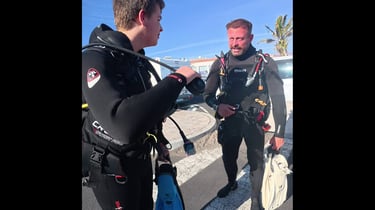
Short answer: no.
Slightly longer answer: it's harder than sitting on a sunlounger, maybe a touch harder than darts, easier than most things you'd describe as a sport, and genuinely achievable for almost any reasonably healthy adult on the first attempt.
But I know that's not actually what you're asking. What you're really asking is: will I be able to do it? Will I embarrass myself? Will I panic? Will I be the only person who can't manage it?
And those are fair questions. So let me answer them properly.
What Makes People Think Scuba Diving is Hard
Most people arrive at a try dive with one of three worries:
1. The physical side — they think it requires strength, fitness, or athletic ability they don't have.
2. The technical side — they think there's a lot to learn and remember and they're going to do something wrong.
3. The psychological side — they think they'll panic underwater and embarrass themselves.
All three are understandable. All three are also largely unfounded, and I'll explain why.
Is Scuba Diving Physically Hard?
No. Genuinely, no.
Scuba diving — particularly a try dive — is less physically demanding than a brisk walk. The equipment does the work. Your buoyancy control device keeps you at the right depth. Your fins move you through the water with minimal effort. The wetsuit keeps you warm. You are not fighting anything. The most physical part is the walk to the water.
Physically, scuba diving is neither difficult nor strenuous — a try dive is far less demanding and requires far less energy or stamina than other popular sports such as running, spinning, or tennis. I've had students in their seventies, students recovering from knee surgery, students who haven't done anything more athletic than a gentle swim in years — and they've all managed it comfortably.
The main physical requirements for a try dive are: be in reasonable general health, be comfortable enough in water that you're not in a state of panic before we start, or at least be prepared to take your time and calm down, and be able to breathe slowly and calmly through your mouth. That's the list.
South Tenerife also helps enormously here. With water temperatures ranging from 19°C in winter to 24°C in summer, calm conditions at many dive sites, and visibility often exceeding 30 metres — you're not contending with cold, murky, choppy British coastal water. You're in warm, clear, gentle Atlantic ocean. It removes a lot of the physical challenge before you've even got in.
Is Scuba Diving Technically Hard?
There's a bit to learn — but less than you think, and none of it is complicated.
In the briefing before a try dive, we cover: how to breathe through the regulator (slowly, continuously, through your mouth), how to equalise your ears on the way down (pinch your nose, blow gently — exactly like a plane), the hand signals we'll use underwater, and what to do if anything feels wrong (signal me, we go up — that's it).
The whole thing takes about 30 to 45 minutes. By the end of it, the vast majority of people feel ready. Not just told they're ready — actually ready, because we've done it in the shallow water first and they've already taken their first breath underwater in a controlled setting before we go anywhere.
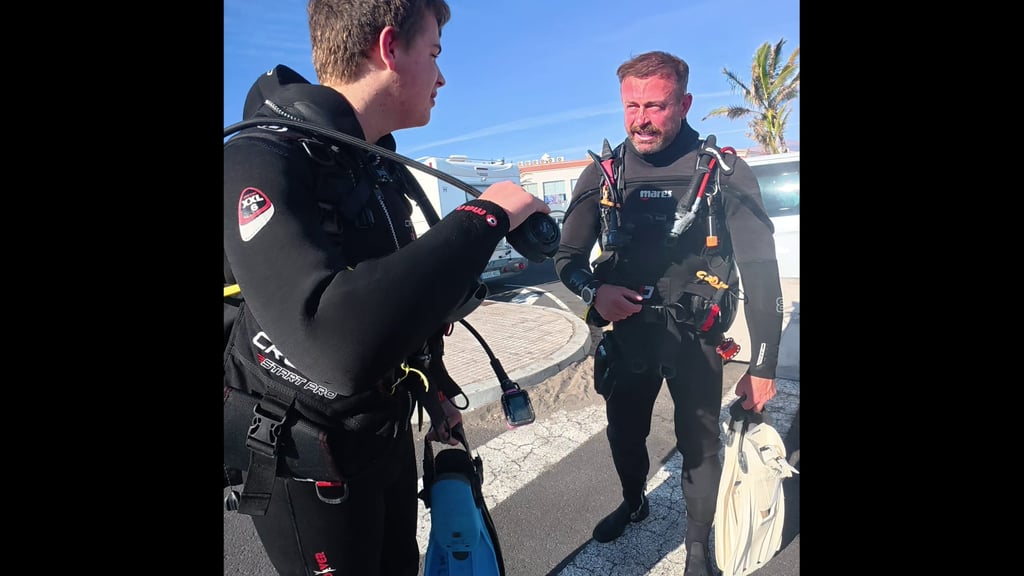
The technical skills involved in a try dive are genuinely minimal. You're not operating the equipment independently — I'm managing everything. Your job is to breathe, move gently with your fins, and look at what's around you. I handle the rest, unless your comfortable and want to do it yourslf, which you'll find is easier than you think.
Will I Panic?
Maybe a little flutter of nerves. Probably not full panic. And here's why.
The shallow water practice that happens before every try dive exists precisely to get your brain comfortable before your body is committed to anything. By the time you've spent a few minutes, or as long as you want, breathing underwater in waist-deep water, doing a couple of basic skills, and realising that it's actually fine — your nervous system has already updated its threat assessment. The ocean doesn't feel like a surprise anymore. It feels like somewhere you've already been.
The moment most people describe as the turning point is the first breath through the regulator. Your brain has been telling you your whole life that breathing underwater is not a thing you do. The first breath contradicts that. It takes a few seconds to process — and then something shifts.
After that, the anxiety tends to drain away fairly quickly and get replaced by something closer to wonder.
That said — I've been doing this long enough to read people. If someone is genuinely struggling, genuinely not comfortable, we slow everything down or we surface. There is no shame in that, no pressure, no time limit. At Sea Wolf Scuba I work in very small groups — usually just one or two students per instructor — which means I can give you my complete attention and adapt to exactly where you are. There's no production line of twelve people waiting behind you. It goes at your pace.
You can see this in action on the Sea Wolf Scuba socials — real students, real first dives, real reactions. Links at the bottom of this post.
What About the Ears?
This comes up constantly and it's worth addressing directly.
Your ears need to equalise as you descend, because water pressure increases with depth. The technique is simple: pinch your nose and blow gently, exactly as you'd do to pop your ears on a plane. Most people get it within the first couple of metres.
If it doesn't work immediately, the answer is to stop descending, try again, and be patient rather than forcing it. Forcing equalisation is the thing that causes discomfort — doing it properly and gently doesn't hurt at all.
I'll be talking you through this throughout the descent. You won't be figuring it out alone.
So What Actually Stops People?
Honestly? The decision to book.
Once people are actually in the water with kit on, the vast majority of them are fine. More than fine — they love it. The hard bit is talking yourself into giving it a go in the first place, which is presumably why you're reading this post rather than already having booked.
So here's my pitch, for what it's worth: Tenerife is one of the best places in the world to try scuba diving for the first time. Warm water, calm conditions, extraordinary marine life — turtles, rays, angel sharks, volcanic formations — and visibility so good it almost doesn't feel real. The conditions remove most of the difficulty before you even start.
And if you book with Sea Wolf Scuba, you're getting a British instructor who's taught complete beginners in all shapes, sizes, ages and starting confidence levels. I've seen people arrive at try dives barely able to look at the ocean and surface an hour later asking how quickly they can do the full course.
Is scuba diving hard? For a try dive in South Tenerife? No. It really isn't.
Ready to Find Out for Yourself?
Try dive with Sea Wolf Scuba: €89 or €129 for two dives in a day (Recommended) . Operating across Costa Adeje, Los Cristianos, Playa de las Américas and South Tenerife. All equipment included. Small groups. British instructor. No experience, no swimming ability, no fitness level required beyond being in reasonable health.
(Lobo thinks it's easy. He's never tried it. He's very confident for someone who spends the whole dive in the bus.)
Sea Wolf Scuba — beginner scuba diving and PADI courses across Costa Adeje, Los Cristianos, Playa de las Américas, Abades and South Tenerife. British instructor. Small groups. No pressure.

Ready to Join the Pack?
Tell us your dates and whether it’s your first time diving.
Quick replies, clear pricing, zero pressure.
Meet Your Instructor (and the Sea Wolf)
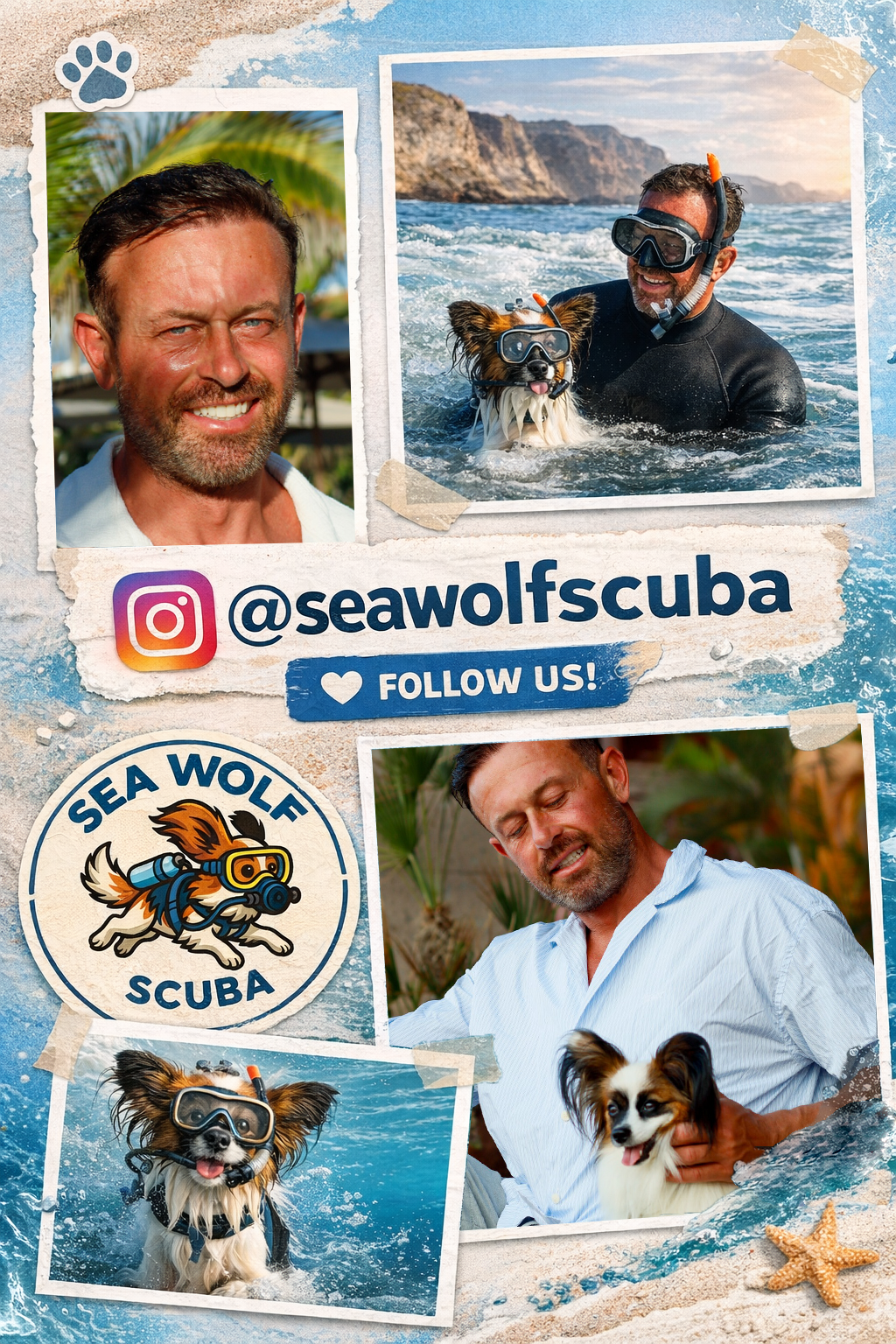
I’m Brian, an English PADI instructor based in south Tenerife. I specialise in calm, confidence-building first dives for beginners.
Sea Wolf Scuba is a small, personal operation — slower pacing, tiny groups, and a strong focus on safety and comfort. I’m usually joined by Lobo, the little “sea wolf” who inspired our logo and supervises the surface intervals.