RELAXED TRY DIVES FOR BEGINNERS IN SOUTH TENERIFE
Is Scuba Diving Safe? Honest Answer from an Instructor
Is scuba diving safe? Yes — especially in Tenerife. PADI instructor Brian explains the real risks, how they're managed, and why beginners are in safe hands.
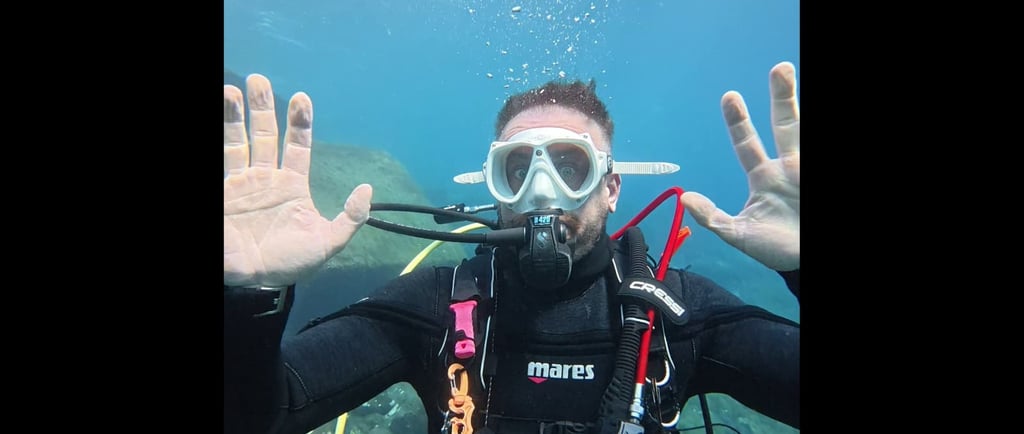
By Brian Harrison — PADI Master Scuba Diver Trainer, Sea Wolf Scuba, Costa Adeje
5/27/20267 min read
Yes. That's the short answer.
But I know that's not enough for most people, because the question isn't really "is it safe in general" — it's "is it safe for me, specifically, with my nerves, my health, my complete lack of experience, in the actual ocean." That's a different question and it deserves a proper answer.
So let's do this properly.
How Safe Is Scuba Diving, Actually?
Here's a stat that tends to surprise people: the fatality rate for scuba diving is roughly comparable to driving a car. Research from the Divers Alert Network puts it at around 16 deaths per 100,000 divers annually — almost identical to the road death rate, and only slightly higher than jogging. Jogging. The most aggressively normal thing you can do.
PADI's own data covering 63 million student dives over nearly two decades recorded a mean death rate of 1.7 per 100,000 student divers per year. Student divers — people learning, doing their first open water dives, the highest-risk group. Still lower than most people would guess.
The most common medical issues associated with scuba diving? Sunburn, seasickness and dehydration. Not exactly the stuff of nightmares.
Now — does that mean there are zero risks? No. Any honest instructor will tell you there are risks, and dismissing them entirely would be doing you a disservice. But the risks are well understood, largely preventable, and managed through training. Which is rather the whole point of doing this with a qualified instructor rather than just strapping on a tank and having a go.
What Are the Actual Risks?
The main risks in scuba diving come down to a handful of things:
Pressure-related issues — specifically ear squeeze (not equalising properly on the way down) and decompression sickness (ascending too quickly). Both are almost entirely preventable with proper technique. Ear equalisation is something we go through thoroughly before every single dive. Decompression sickness essentially doesn't apply to try dives and beginner depths — it becomes relevant at deeper recreational diving, not at 6 to 12 metres where beginners are working.
Panic — the psychological response to being underwater can affect some people, particularly on a first dive. This is the one I take most seriously, because it's the most unpredictable. My answer to it is the shallow water practice that happens before every dive, small group sizes, and genuinely going at your pace. By the time we're in open water, your brain has already been underwater and knows it's fine.
Equipment failure — modern scuba equipment is robust, redundant, and regularly serviced. All Sea Wolf Scuba equipment is maintained properly. This is actually one of the reasons I tell people we're not the cheapest option — cutting corners on equipment maintenance is not something I do.
Marine life — sharks are what everyone asks about. The reality in South Tenerife is angel sharks, which lie on the sandy bottom and have absolutely no interest in divers. They look spectacular and they will not hurt you. There are no aggressive shark species in these waters. The only thing in the sea near Los Cristianos and Costa Adeje that might genuinely inconvenience you is a weever fish buried in sand near the shoreline — and you'd have to step on it to have a problem, but when with me you'll have boots on, which you wouldn't if you were just paddling.
Is It Safe for Beginners Specifically?
This is the version of the question most people actually mean, and the answer is yes — with the right setup.
"The right setup" matters more than most people realise. A try dive with a qualified, attentive instructor in calm, shallow, clear water is a very different proposition to an unsupervised dive off a boat in open ocean. The conditions in South Tenerife — sheltered bays, warm water, excellent visibility, minimal currents — are genuinely about as forgiving as open water gets anywhere in the world.
Excellent visibility, mild currents, and year-round conditions make Tenerife scuba diving suitable for beginners and experienced divers alike. That's not marketing — that's just what the water here is actually like. The Atlantic around the south of the island is warm, calm and clear in a way that removes most of the environmental challenge from a first dive before you've even got your kit on.
The PADI Discover Scuba Diving programme — which is what a try dive runs under — is specifically designed for complete beginners with no experience. Maximum depth of 6 metres on the first dive. Skills practised in shallow water first. Instructor in the water with you the entire time. The programme exists precisely because PADI wanted a way to let complete beginners experience diving safely, and it's been refined over decades to do exactly that.
What About Medical Conditions?
This is where I want to be straight with you rather than just reassuring.
Most people are absolutely fine to dive. But certain medical conditions do require either a doctor's sign-off or mean diving isn't appropriate. The PADI medical questionnaire covers all of this — it's not long, it's not complicated, and you'll review it in before booking. The conditions that commonly need attention include:
Heart conditions — particularly recent cardiac events or uncontrolled arrhythmia
Epilepsy — this one typically rules out diving
Lung conditions — specifically anything that affects air trapping (asthma needs individual assessment, not automatic exclusion, asthma 26 years ago as a child for example, we assume is not an issue)
Ear problems — recent ear surgery or perforated eardrum needs sorting before diving
Pregnancy
If you've got any of these, tell me when you get in touch. I'll give you an honest answer rather than a generic disclaimer, and if a doctor's note is needed we can talk through what that involves. Most conditions are either fine or require a simple additional step — they're not automatic deal-breakers.
What isn't on the list: being unfit, being nervous, being a bad swimmer, being old, being overweight. None of those are medical contraindications to diving. I've taught people across all of those categories without issue.
Is the Equipment Safe?
Yes, when it's properly maintained by someone who actually cares.
All Sea Wolf Scuba equipment is regularly serviced, the business is my baby, and all the kit is mine, everything is serviced by an external prioffesional or only months old and not due a service. Regulators, BCDs, tanks — all of it. I'm not running a high-volume operation where equipment gets thrashed through dozens of students a day and serviced once a year if you're lucky. Small operation, properly looked after kit which a I treat as if its my own, because it is, no shortcuts.
The wetsuit will keep you warm. The BCD will control your buoyancy. The regulator will deliver air on demand every single time you breathe. Modern scuba equipment has redundancies built in — if a primary system has a problem, there's a backup. Equipment failure serious enough to cause a problem on a supervised beginner dive is vanishingly rare when the kit is maintained properly.
What Makes South Tenerife Safer Than Other Destinations?
A few things that genuinely matter for beginners:
Shore diving rather than boat diving. Most beginner dives in South Tenerife — around Los Cristianos, Costa Adeje and Playa de las Américas — are shore dives. You walk in from a beach or a gentle entry point. You're never jumping off a moving boat into open water. This removes a significant source of anxiety and logistical complication for first-timers.
Calm, sheltered water. The south coast is protected from the predominant trade winds that affect the north of the island. Conditions are consistently calmer, which matters enormously for beginners.
Warm water. At 19 to 24°C year-round, you're diving in water that keeps you comfortable and doesn't add cold-water stress on top of everything else you're managing.
Visibility. Regularly hitting 20 to 30 metres. When you can see clearly in every direction, the underwater world feels less claustrophobic and more manageable. Murky water is psychologically much harder for beginners.
No dangerous marine life. I'll keep saying it because people keep worrying: there is nothing in the water off South Tenerife that is a meaningful threat to a supervised beginner diver.
What About Group Size?
This matters more than people give it credit for, and it's worth asking any dive operator you're considering.
A ratio of one instructor to four+ students/clients is a very different safety proposition to one instructor to two students. At Sea Wolf Scuba the maximum is two students per instructor — and I'm usually the only instructor, which means it's typically just you and me. That means my attention is entirely on you. I can see how you're doing, I can anticipate a problem before it becomes one, and I can slow things down or change the plan if the situation calls for it.
I've been doing this long enough to read people. I'll often know before you do if something needs addressing. That's not something you can replicate with a group of twelve people.
The Honest Bottom Line
Scuba diving is safe. Scuba diving in Tenerife — in calm, warm, clear water with a qualified instructor and well-maintained equipment and a maximum group size of two — is about as safe a version of it as you'll find anywhere.
There are risks, like any activity worth doing. They are well-understood, largely preventable, and actively managed throughout every dive I run. The alternative — never doing it because something might theoretically go wrong — means missing out on one of the most extraordinary experiences available to a human being without a submarine.
You can see real students doing real first dives on the Sea Wolf Scuba socials — how the briefing actually goes, how people look when they surface, the whole thing. Links at the bottom of this page.
Want to Talk It Through?
If you've got specific concerns — a medical condition, a previous bad experience in water, something that's been putting you off — drop me a message. I'd rather have an honest conversation upfront than have you show up anxious about something we could have sorted beforehand.
Sea Wolf Scuba operates across Costa Adeje, Los Cristianos, Playa de las Américas and South Tenerife. British instructor. Small groups. All equipment included and properly maintained.
(Lobo has never had a safety briefing. He refuses. He's fine.)
Sea Wolf Scuba — PADI try dives and beginner courses across Costa Adeje, Los Cristianos, Playa de las Américas, Abades and South Tenerife. British instructor. Small groups. No pressure.

Ready to Join the Pack?
Tell us your dates and whether it’s your first time diving.
Quick replies, clear pricing, zero pressure.
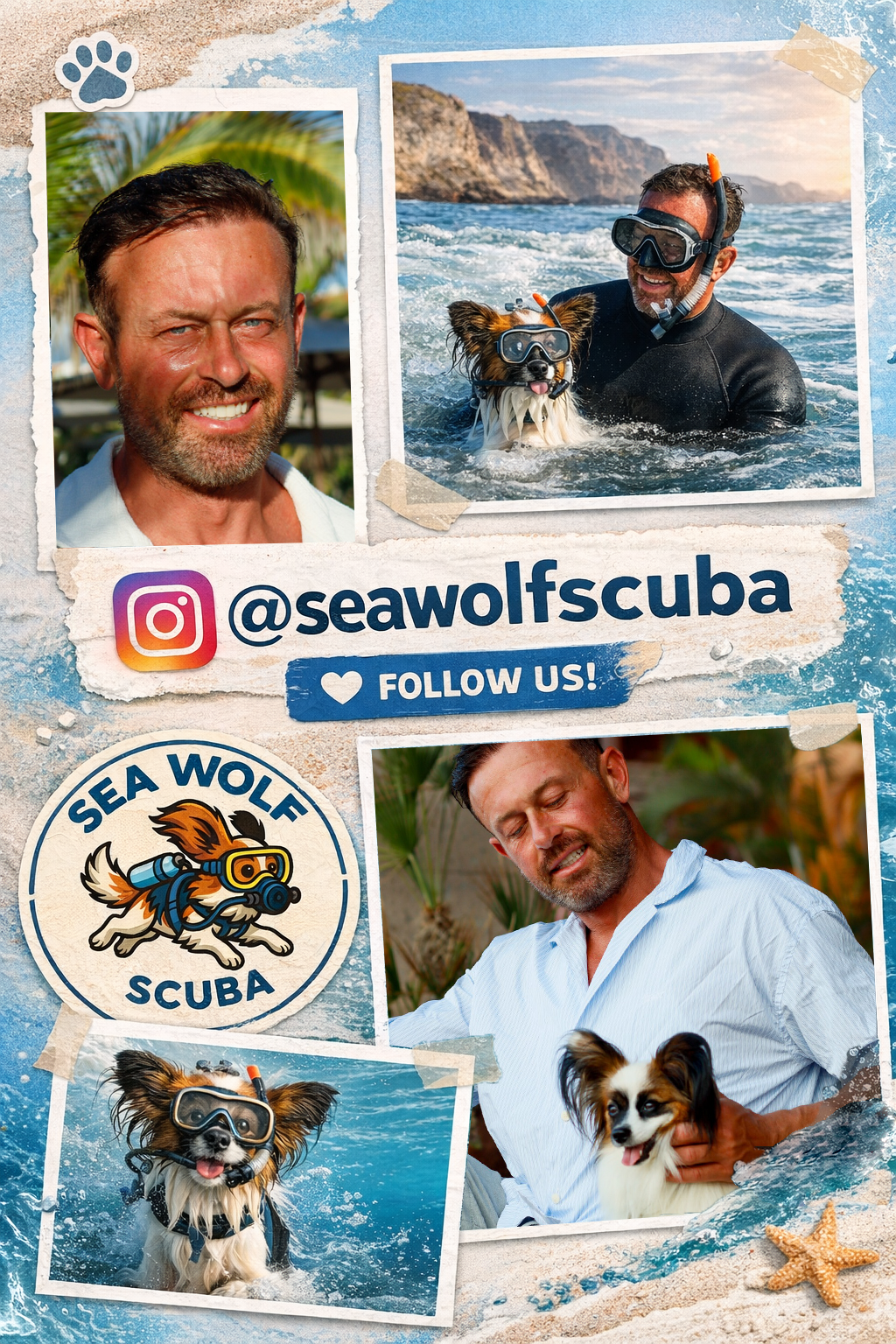
Meet Your Instructor (and the Sea Wolf)
I’m Brian, an English PADI instructor based in south Tenerife. I specialise in calm, confidence-building first dives for beginners.
Sea Wolf Scuba is a small, personal operation — slower pacing, tiny groups, and a strong focus on safety and comfort. I’m usually joined by Lobo, the little “sea wolf” who inspired our logo and supervises the surface intervals.