RELAXED TRY DIVES FOR BEGINNERS IN SOUTH TENERIFE
Try Dive Tenerife: What to Expect | Sea Wolf Scuba
Make a try dive Tenerife with a British PADI instructor. First scuba dive in Costa Adeje & Los Cristianos. Small groups, no experience needed, all equipment supplied. Get in touch!
By Brian Harrison, PADI Master Scuba Diver Trainer · Sea Wolf Scuba · Costa Adeje, Tenerife
5/27/20267 min read
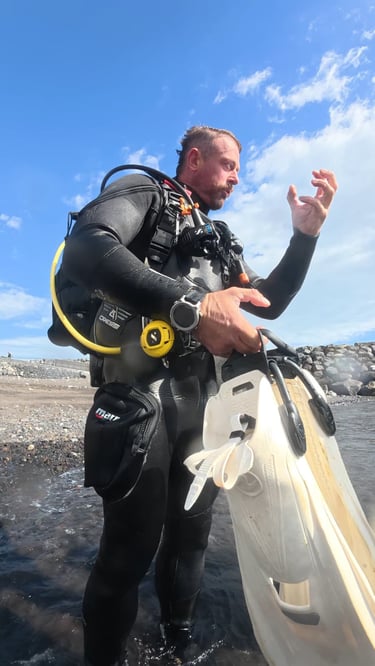
So you're sitting by the pool in Costa Adeje, cold drink in hand, and you keep staring at the sea thinking: should I?
Maybe you've already Googled "try dive Tenerife" three times. Maybe your partner did it last year and won't stop going on about it. Maybe you just want something to talk about at work that isn't a sunburnt nose and an all-inclusive buffet.
Whatever's brought you here — welcome. You're in the right place.
A try dive (officially called a PADI Discover Scuba Diving experience) is exactly what it sounds like: a proper, supervised dive in the actual ocean, no certification required, no prior experience needed. You don't need to be able to swim. You don't need to be particularly fit. You just need to be 10 or older, in reasonable health, and curious enough to say yes.
Here's exactly what happens, from the moment you book to the moment you surface grinning like an idiot. Which, for the record, you will.
Step 1: You Book. We Sort the Rest.
When you get in touch with Sea Wolf Scuba — whether that's initially through the website or the socials we'll organise everything over Whatsapp — We can quicly run over availbility and I'll send you a copy of the medical, not to complete, just to review and ensure you're in good health, or if we need a doctors opinion. Nothing scary, just standard PADI stuff. Heart conditions, epilepsy, that kind of thing. Most people sail through this part without issue.
I'll give you a pickup time and location which will noramally be your hotel— Sea Wolf operates across South Tenerife, so whether you're in Los Cristianos, Playa de las Américas, Costa Adeje or anywhere in between, we'll get you sorted.
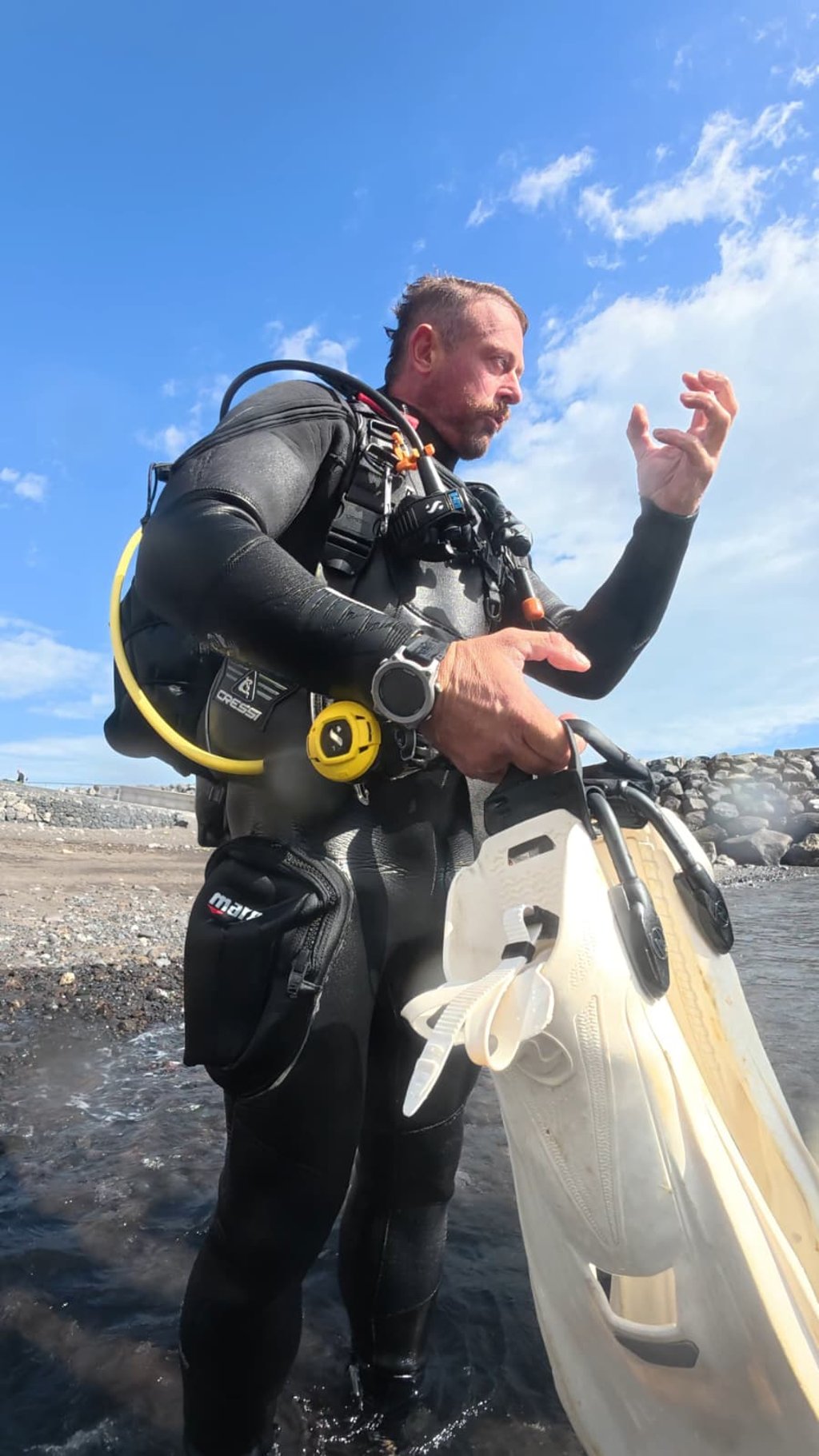
What to bring: Come in swimwear with clothes over, a towel, change of clothes if you like, and a bit of excitement. That's genuinely it. Everything else — wetsuit, tank, mask, fins, regulator, buoyancy jacket — is included. Leave the GoPro at the hotel. Focus on the experience first.
Step 2: The Briefing (The Bit That Looks Like School But Isn't)
Before anyone gets in the water, we sit down for a briefing. This usually takes around 10-15 minutes and it's where the magic starts, because by the end of it, most people's nerves have already halved, we'll have almost cetrainly covered your "What if?...." concerns
We cover:
How to breathe underwater (through your mouth, slowly and continuously — you'll get the hang of it faster than you think)
How to equalise your ears — same as yawning on a plane, basically. Pinch your nose and blow gently. Nobody tells you this is actually satisfying once you crack it.
The hand signals we'll use underwater — OK, stop, up, down, look at that (a turtle, probably)
What the kit does and how to use it
What to do if you feel uncomfortable — which is just: signal me, and we work togehter, or we go up. Simple as that. No drama, no pressure.
I want to be straight with you here: I teach small groups. Max two people to an Instructor, who is normally only me unless you're a family of 4 for example. You're not being processed through a dive factory. If you've got questions, ask them. If you want to go over something twice, we go over it twice, if I want to go over something twice, try and stop me! I love a yap! There's no stupid question in diving — there's only questions you didn't ask and then wished you had.
You can see how these bits of briefings actually go on the Sea Wolf Scuba socials — links at the bottom of this page. It's a lot more relaxed than it sounds on paper.
Step 3: Shallow Water Practice
Before the real dive, we spend a bit of time in shallow, calm water — typically waist to chest depth. This is your chance to practise breathing through the regulator, get the feel of the kit, and do a couple of basic skills with your head underwater.
This is where most people have their lightbulb moment.
The first breath through a regulator is genuinely weird. Your brain screams you should not be breathing here, this is water, stop it. Then, about ten seconds later, your brain goes oh. Oh this is fine actually. This is brilliant.
We'll run through clearing your mask if water gets in (it won't end you, I promise), checking you can equalise comfortably as we go a little deeper, and hovering. By the time we walk out of the shallow water, you're ready.
Step 4: The Dive
Right. This is the bit you came for.
We descend slowly — there's no rush, and we go at your pace. I'll be right next to you the entire time. The maximum depth on a first try dive is 6 metres, second dive we can go to 12. In practice, most first-timers are perfectly happy at 6 to 9 metres, which is still an absolutely stunning world you've never seen before.
The waters off South Tenerife are genuinely special. Visibility regularly hits 20 to 30 metres — on a good day it looks like diving in a swimming pool that happens to have amazing Sea life in it, but you only get to see it all if you GO SLOW, so again, we aren't rushing. Water temperature sits between 19°C in winter and 24°C in summer, so you're always warm in a wetsuit.
What will you see? Honestly, it depends on the site and the day, but you're in South Tenerife — shoals of colourful Atlantic fish, and at sites like Abades on the southeast coast, there's a serious chance of bumping into green turtles grazing on the seagrass beds. Cuttlefish are reasonably common, Rays are often about. Octopus turn up when they feel like it, we try and find these by spotting their little garden walls they like to form. Angel sharks occasionally materialise out of the sand like something from a nature documentary.
The dive itself lasts around 30-45 minutes underwater. You'll spend most of it just looking around with your mouth slightly open (which is fine — the regulator keeps the water out).
At some point, probably around 10 minutes in, hopefully something clicks. The breathing becomes automatic. The weightlessness stops feeling strange and starts feeling like the most natural thing in the world. Most people describe it later as the closest thing to flying they've ever experienced. But don't worry if this doesn't occur, I (or another instructor) are never beyond arms reach, and if you're struggling to control your bouyancy as an example, I'll do it for you, you have nothing to worry about, either way.
That's the moment I do this job for, every single time.
Step 5: Back on the Surface
We ascend slowly — diving rule number one, always — and wade back in. Your face will be doing something embarrassing. Everyone's does. I've never brought a first-timer out of the water who wasn't smiling.
We debrief briefly, go through what you saw, and I answer whatever questions have bubbled up (pun absolutely intended). If you want to go again — which a decent percentage of people do — we can talk about a second dive or whether a full PADI Open Water course makes sense for you.
There's no sales pressure. Ever. If a try dive is all you want, brilliant — that's a complete experience in itself. If you want to take it further, I'll tell you honestly what that involves and whether it fits your holiday. But seriously, No pressure, I think I had 9 years before my first try dive and actually commitingto my open water certification. Either way, you'll leave with a head full of memories and probably some decent underwater photos too.
A Few Practical Things People Always Ask
Do I need to be a good swimmer? You need to be reasonably comfortable in the water, we're still going in the water, ha. But no, you don't need to be swim. More on that soon.
Can my kids do a try dive? Yes, from age 10 upwards. There's a junior version of the programme and kids, in my experience, are usually less nervous than adults. This can also be done as a family, adults and kids together, we would just stay within the depths permisable to youths, same bay, same sea, same sealife. More on that in a future post too.
Will my ears hurt? Not if we equalise properly, which we will. I'll remind you every metre or two on the way down. Remember you've equalised your ears all the way to Tenerife on the plane, without paying it too much attention.T hink of it as a superpower you didn't know you had.
What if I panic? Totally valid question. The honest answer: most people feel some flutter of nerves on the descent. What I do is slow everything down. There's no rush, no target, no timetable and I'll be right, immeditately infront of you. If something doesn't feel right, we deal with it there and then. The shallow-water practice beforehand exists precisely to make sure you're confident before we go anywhere. And I've been doing this long enough to read people — I'll know before you do if we need to take a breath (metaphorically) and reset.
Is it worth it? Every. Single. Time.
Ready to Book Your Try Dive in Tenerife?
Sea Wolf Scuba offers try dives from €89 (single person) or €129 for two — operating across Costa Adeje, Los Cristianos, Playa de las Américas and surrounding areas in South Tenerife. Small groups, personal attention, British instructor, one of the few British Instructors on the island. I can tell you inadvance, we are not the cheapest, but when its life maintaining equipment, or temporary instructors in a high staff turnover enviroment, you get what you pay for.
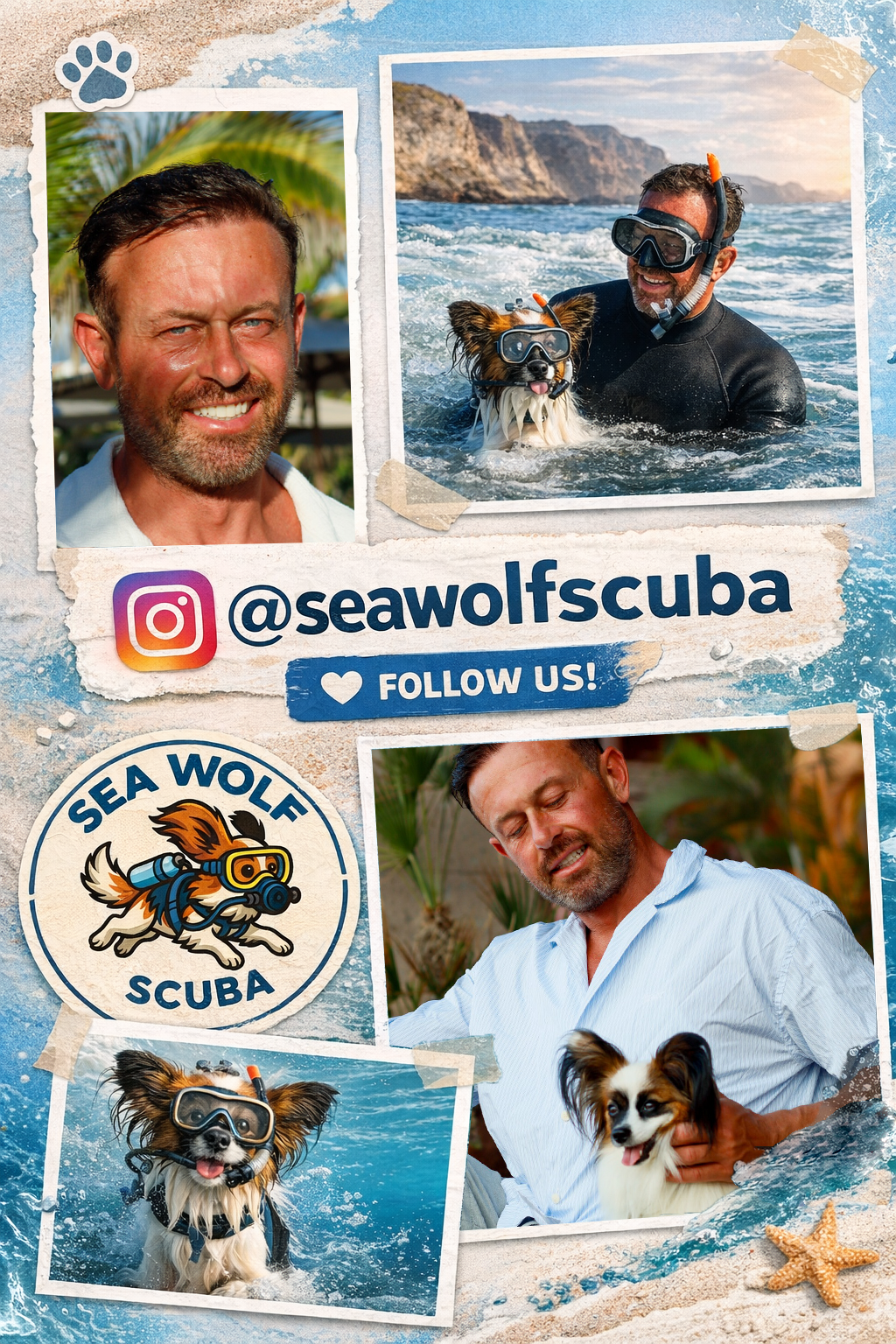
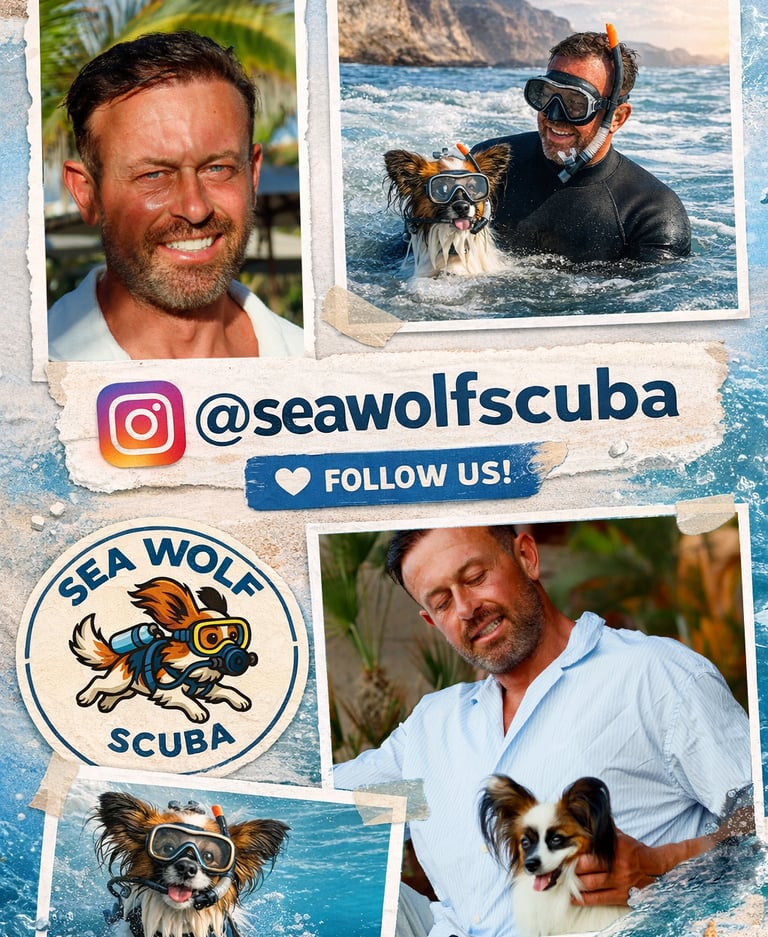
Want to see what it actually looks like in real life? Check out our TikTok and Instagram — there's footage of real students on real dives, plus Lobo (he's the Papillon, he doesn't dive, he waits in the mini bus and judges everyone):
Get in touch and let's get you underwater.
Sea Wolf Scuba — PADI try dives and courses in Costa Adeje, Los Cristianos, Playa de las Américas, Abades and across South Tenerife. British instructor. Small groups. No pressure.

Ready to Join the Pack?
Tell us your dates and whether it’s your first time diving.
Quick replies, clear pricing, zero pressure.
Meet Your Instructor (and the Sea Wolf)
I’m Brian, an English PADI instructor based in south Tenerife. I specialise in calm, confidence-building first dives for beginners.
Sea Wolf Scuba is a small, personal operation — slower pacing, tiny groups, and a strong focus on safety and comfort. I’m usually joined by Lobo, the little “sea wolf” who inspired our logo and supervises the surface intervals.