RELAXED TRY DIVES FOR BEGINNERS IN SOUTH TENERIFE
PADI Courses Tenerife | Specialities & Diver Training
PADI courses Tenerife — Advanced Open Water, specialities, Rescue Diver and Divemaster training. British PADI instructor, small groups, South Tenerife.
By Brian Harrison — PADI Master Scuba Diver Trainer, Sea Wolf Scuba, Costa Adeje
5/27/202610 min read
So you've got your Open Water. You've done a few dives. You've discovered that breathing underwater is, in fact, excellent. And now you're wondering what comes next.
Or maybe you're the opposite — you got certified years ago, life got in the way, and you haven't been in the water since. You're on holiday in Tenerife and wondering if you can just pick up where you left off.
Or perhaps you're already a confident, regularly diving diver who wants to actually do something with a holiday week beyond fun dives with a random group.
All three of you are in the right place. This post covers the full progression from newly certified all the way through to Divemaster — and what each step actually means in practice, not just on paper.
First — The Correct Order of Things
This catches people out constantly, so let's be clear upfront.
The progression in recreational PADI diving goes:
Open Water → Advanced Open Water → Specialities → Rescue Diver → Divemaster
Some people who've just done their Open Water want to jump straight to specialities. That's understandable, especially if you're in the UK and want ot do drysuit, or if you think Night Diver sounds more exciting than Advanced Open Water. But the Advanced Open Water course is what unlocks the deeper, more interesting diving that makes most specialities worth doing, and includes samples of the specilalities. It also makes you a noticeably better diver in ways that the Open Water course doesn't have time to develop.
Do it in order. You'll thank yourself later.
PADI ReActivate — For the Returning Diver
Before anything else, this one's for the people who've been out of the water for a while.
If you're a certified diver who hasn't dived in a year or more — or even a few years — a ReActivate session is the sensible starting point. It's not a course. It's not a recertification. It's a refresher that brings you back up to speed on the skills and knowledge that go stale when you're not using them.
It combines updated digital theory (done on your phone or laptop before we meet) with a practical in-water session running back through the core skills — buoyancy, regulator recovery, mask clearing, emergency procedures. By the end of it you're diving with confidence rather than hoping you remember how everything works.
Most people are surprised how quickly it comes back. The body remembers more than the brain thinks it does. But having a structured refresh before getting back in the ocean — rather than just winging it and hoping for the best — makes the experience far more enjoyable and far safer. Also, you might remember the basic, the big ticket items, how everything works, but it's unlikey you remember the finer details, we'll dot those Is and cross those Ts again.
If you're a lapsed diver arriving in Tenerife and wanting to dive again, get in touch before your trip and we'll sort a ReActivate session as the starting point.
Advanced Open Water — The Course That Actually Makes You a Diver
The PADI Advanced Open Water Diver course is five adventure dives across two days, covering deep diving and underwater navigation as mandatory elements, plus three more from a range of options. Each adventure dive can count as the first dive of the corresponding speciality course — so it's also a head start on whatever comes next.
More importantly, it's where most people go from feeling like a diver to actually being one.
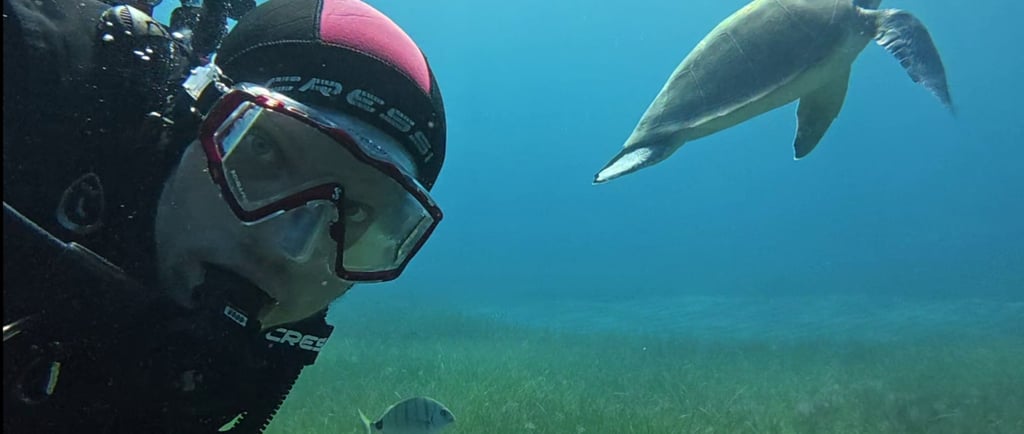
The Open Water course teaches you the fundamentals. The Advanced Open Water course gives you the depth limit to go from 18 metres to 30 metres, the experience to start developing real underwater instincts, and the qualification that unlocks most of the interesting diving available in Tenerife — including the wreck at Tabaiba, which I'll get to shortly.
It also opens up Rescue Diver, which is where things get serious.
Minimum age is 12. Minimum logged dives before starting: none beyond your Open Water certification.
Some people chose to do Open Water and then directly go on to Advanced Open Water, I think this is the better way, why log 20 dives between picking up bad habits before spending any genuine time on bouyancy for example.
Speciality Courses — Unlocking Specific Parts of the Underwater World
Once you've got your Advanced Open Water, speciality courses become available. Each one focuses on a specific discipline and can typically be completed in one to two days. Here's what Sea Wolf Scuba offers and why each one is worth doing.
Peak Performance Buoyancy - The fundamentals
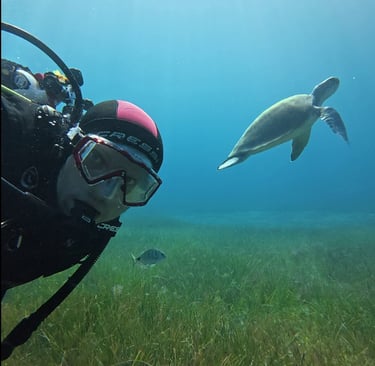
Buoyancy is the foundation of everything in diving. Your air consumption, your interaction with marine life, how comfortable you feel underwater, how good you look on someone else's GoPro — all of it comes down to buoyancy. The difference between a diver with excellent buoyancy and one without is the difference between gliding effortlessly past a turtle at arm's length and crashing into the sand trying to stop yourself sinking while the turtle makes a dignified exit.
The Open Water and Advanced courses introduce buoyancy. This course spends extended time on it — proper weighting, trim, breath control, hovering, moving efficiently through the water. Most divers who do it describe it as the session where everything finally clicked. It's also one of the fastest courses to complete, and the benefits show up on every single dive you do for the rest of your life.
Deep Diver — Go Further Down
The Advanced Open Water takes you to 30 metres. The Deep Diver speciality takes you to the recreational limit of 40 metres.
That extra 10 metres sounds modest. It isn't. Below 30 metres is a different world — different light quality, different species, more dramatic topography, and access to wrecks like El Peñón at Tabaiba that sit right in that depth range. The Deep Diver course teaches proper deep dive planning, managing nitrogen narcosis, emergency procedures at depth, and how to get the most out of time at deeper depths before your no-decompression limits bring you back up.
Four dives over two days. Minimum age 15. Advanced Open Water required.
Wreck Diver — El Peñón, Tabaiba
I'm going to talk about this one differently, because the wreck we use for it is genuinely one of the most interesting dive sites in the Canary Islands and deserves more than a bullet point.
El Peñón at Tabaiba sits on the northeast coast of Tenerife, about 40 minutes from Costa Adeje. It's a 27-metre tugboat called the Cepsa Segundo, built in Seville in 1958 and spent decades working the port of Santa Cruz. In 1971 it was actually sunk accidentally while helping berth the British ocean liner Canberra — the same ship later used as a hospital vessel in the Falklands War and which appeared in the James Bond film Diamonds Are Forever. Not a bad footnote for a tugboat.
It was salvaged, repaired, returned to service, and finally deliberately sunk in July 2006 off Tabaiba to serve as an artificial reef. It rests at 20 to 32 metres, heeled about 30 degrees to starboard, fully penetrable — bridge, engine room, cargo hold. Since sinking it's been completely colonised by marine life: barracuda, moray eels famous among local divers, octopus, cuttlefish, garden eels, angel sharks, rays, sponges and corals covering every surface. Visibility at the site is consistently excellent.
It's an extraordinary dive. Shore access, no boat needed, a guide tube from the entry point leads directly to the wreck. Open Water divers can swim over the top of the wreck. Deep divers can swim down to the bottom.o Wreck divers can penetrate it fully.
The Wreck Diver speciality teaches the skills to do that safely — wreck navigation, line laying, managing penetration within the light zone, understanding wreck structure. Four dives, two days, Advanced Open Water required.
If you come to Tenerife and you have your Advanced — you should dive El Peñón. The Wreck Diver course is the way to get the most out of it.
Night Diver — A Different World After Dark
Quick note first: you don't need the Night Diver speciality to go night diving. As a certified diver you can dive at night with a qualified guide — Sea Wolf Scuba offers night dives as a standalone product, check the night dives page on the website.
What the Night Diver speciality does is develop you beyond that. It teaches the specific skills and knowledge that make night diving genuinely comfortable rather than just manageable — torch techniques, navigation in the dark, emergency procedures at night, understanding how marine life behaves differently after sunset.
And how does it behave? Very differently. Nocturnal species come out — octopus hunting actively, moray eels patrolling, lobster and crab emerging from hiding. The fish that were darting around during the day are motionless, asleep in the coral, completely unbothered by your torch. Bioluminescent plankton turn your hand movements into trails of cold blue light if conditions are right. The same site you dived at midday is completely unrecognisable at 10pm.
It's one of the most memorable diving experiences available. The speciality makes it something you can do independently and safely, anywhere in the world, for the rest of your diving life.
Three night dives. Can often be completed over two evenings.
Self Reliant Diver — For Experienced Divers Only
Diving with a buddy is fundamental to recreational diving and that's not something to dismiss casually. But there are legitimate situations where experienced divers need to dive alone — underwater photography, survey work, specific research dives, or simply circumstances where a buddy isn't available and the dive is important enough to do anyway.
The Self Reliant Diver course teaches the redundant equipment configuration, emergency procedures, and dive planning required to make solo diving as safe as it practically can be. It's an advanced speciality with meaningful prerequisites — a significant number of logged dives, Advanced Open Water minimum, and a genuine reason to be doing it.
If you're an experienced diver who knows why you want this certification, get in touch. If you're a newer diver who thinks it sounds cool — do the other courses first. This one will wait.
AWARE Conservation Courses
Sea Wolf Scuba also offers PADI AWARE Shark and Ray Conservation and PADI AWARE Coral Reef Conservation specialities for divers interested in the environmental side of diving. Tenerife is home to angel sharks, rays, and marine ecosystems that genuinely benefit from informed, conservation-minded divers. If that's your thing, ask me about it.
Rescue Diver — The One That Gets Serious
Most divers who've done their Rescue Diver course describe it as the most significant course they've ever done. Not the most exciting — the most significant.
It's not about becoming a lifeguard. It's about becoming a diver who actually understands what can go wrong underwater and has the skills to deal with it — for yourself and for the person diving next to you. You'll learn to recognise the early signs of a diver in difficulty before they become an emergency, manage panic (in others and in yourself), handle an unresponsive diver at the surface, and coordinate a proper emergency response.
The mental shift it creates is hard to describe until you've done it. You stop being a passenger on your own dives. You start actually understanding what's happening around you and having the tools to respond to it. Most Rescue Divers describe every dive after the course as feeling more controlled, more confident, and more enjoyable — because the anxiety that most recreational divers carry about "what if something goes wrong" has been replaced with actual knowledge.
Prerequisites: Advanced Open Water, Emergency First Response certification (basic first aid and CPR, a first aid att work certifcate from the UK is sufficient, or, its available through Sea Wolf Scuba), and a minimum of logged dives. Get in touch and we'll talk through where you are and what the path looks like from your current level.
Yes, it's possible to complete your Rescue Diver on a Tenerife holiday. Get in touch well before your trip so we can plan the timing properly.
Divemaster — Going Professional
The Divemaster qualification is the first professional level in PADI diving. It's the point at which you can lead certified divers, assist with courses, and work in the dive industry.
Sea Wolf Scuba takes on Divemaster interns selectively. This isn't a classroom programme — it's real-world experience working alongside me on actual student dives, try dives, and courses in South Tenerife. You'll develop the skills, stamina and logged dives required for the Divemaster qualification while working in one of the best diving environments in Europe, with a small personal operation that actually puts you in meaningful situations rather than carrying kit bags for a busy dive centre.
If you're a serious, experienced diver considering going professional — whether to work in the industry long-term or simply to reach the highest level of recreational qualification — and you want to do it somewhere that treats it as a proper apprenticeship rather than a box-ticking exercise, get in touch and let's have a conversation.
Places are limited and it's done properly or not at all.
What's Available at Sea Wolf Scuba
PADI ReActivate — returning divers, lapsed certification refresh
Advanced Open Water — the essential next step after Open Water
Peak Performance Buoyancy — the one every diver should do
Deep Diver — to 40 metres
Wreck Diver — including El Peñón, Tabaiba
Night Diver — with standalone night dives also available
Self Reliant Diver — for experienced divers with genuine need
AWARE Conservation Specialities — shark, ray and reef conservation
Emergency First Response — first aid and CPR, Rescue Diver prerequisite
Rescue Diver — the course that changes everything
Divemaster — internship, selective intake
All taught in South Tenerife and the northeast coast, in small groups, with personal instruction. Not on a whiteboard. In the actual ocean, on actual dives.
Get in Touch
Tell me where you are in your diving — certification level, how many dives you've logged, what you're interested in, when you're in Tenerife. I'll tell you honestly what's achievable and what makes the most sense as a next step.
(Lobo is not enrolled in any course. His surface intervals are, however, impeccable.)
Sea Wolf Scuba — PADI courses, specialities, Rescue Diver and Divemaster training across Costa Adeje, Los Cristianos, South Tenerife and the northeast coast. British instructor. Small groups. Proper diving.

Ready to Join the Pack?
Tell us your dates and whether it’s your first time diving.
Quick replies, clear pricing, zero pressure.
Meet Your Instructor (and the Sea Wolf)
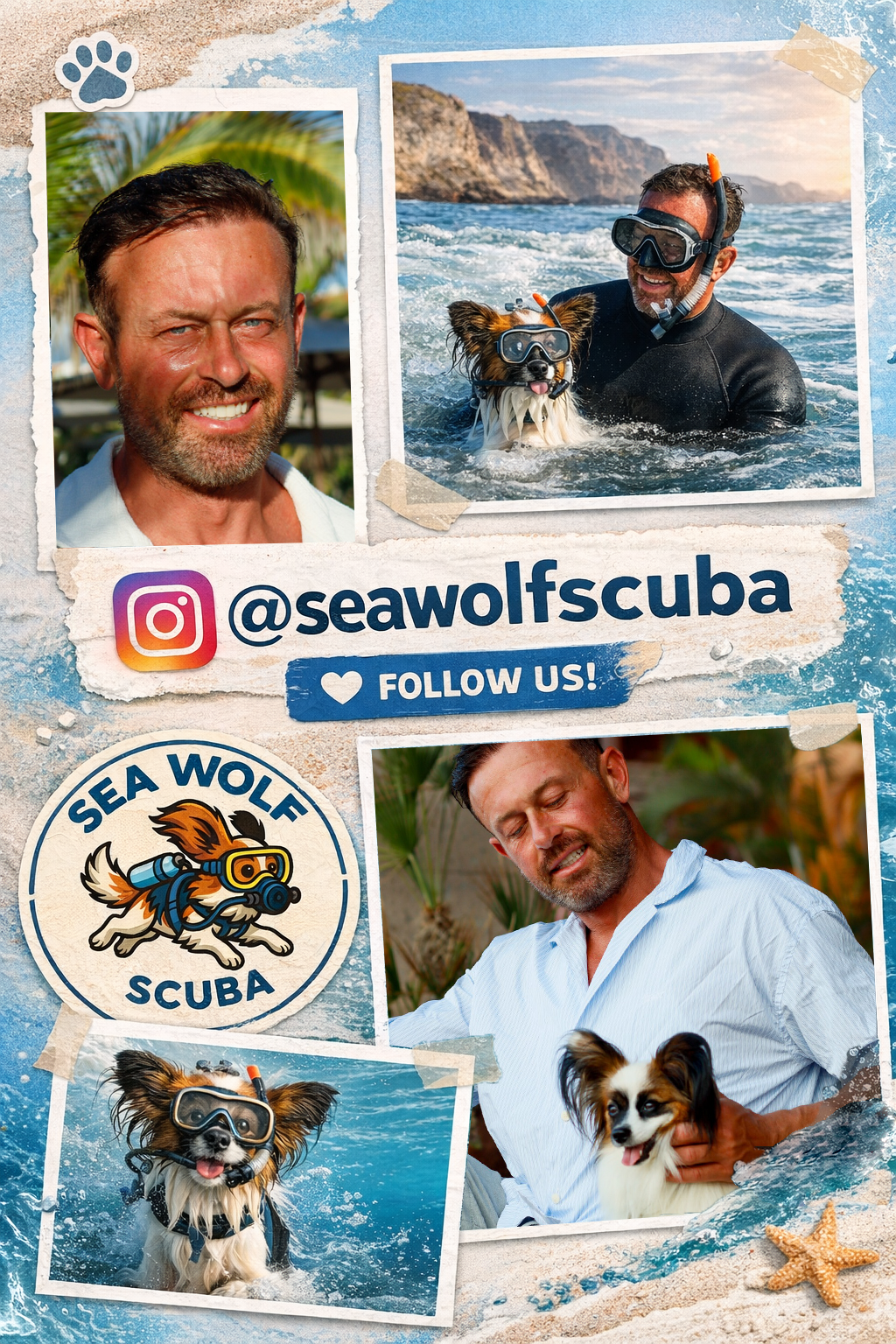
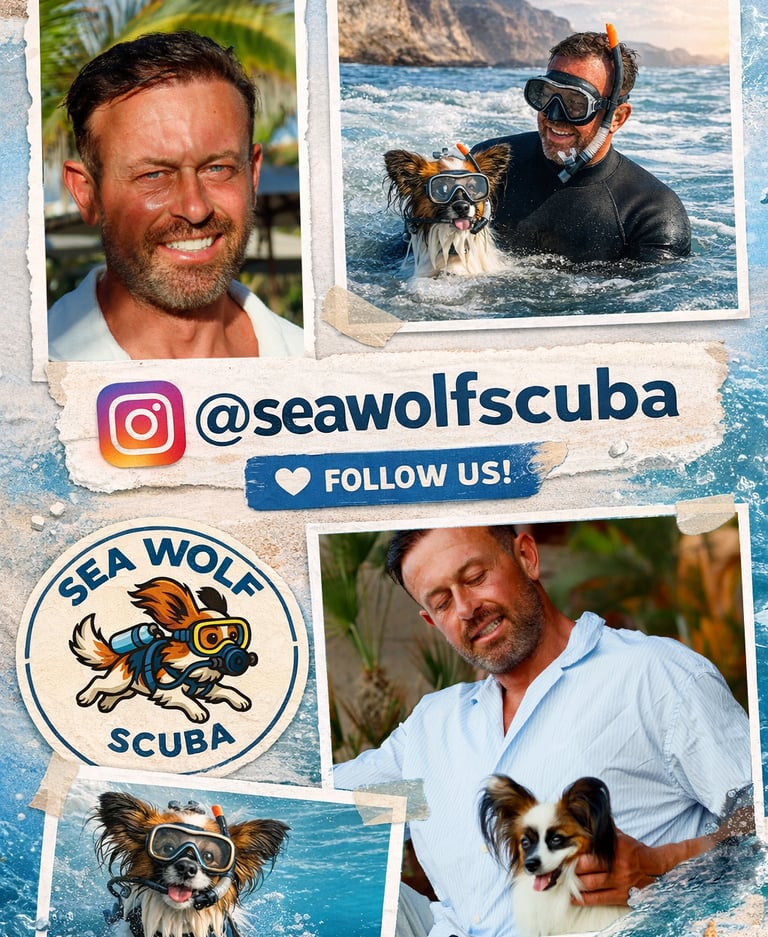
I’m Brian, an English PADI instructor based in south Tenerife. I specialise in calm, confidence-building first dives for beginners.
Sea Wolf Scuba is a small, personal operation — slower pacing, tiny groups, and a strong focus on safety and comfort. I’m usually joined by Lobo, the little “sea wolf” who inspired our logo and supervises the surface intervals.